




New York State Adopts Electronic Wills Act Starting in 2027
A few New York State laws were enacted by Governor Kathy Hochul right before December 31, 2025. One of the most notable new laws is the authorization of electronically signing Wills for New York State residents. Before deciding that this is the right approach for you, it’s important to be aware of the requirements. If you have questions about creating and signing a Will in New York, please consider scheduling a consultation with the experienced New York estate attorneys at Abelaj Law, P.C. by calling 212-328-9568.
Effect Date of New York Electronic Wills Act
The New York Electronic Wills Act was signed into law on December 12, 2025, and takes effect on June 10, 2027. Some provisions are based on existing law, such as the timing of witnesses signing the Will, and other provisions are newly created, such as required court filings.
The electronic Will must contain audit trail data, which likely means that an e-signing platform such as Adobe Sign, Docusign or a similar program must be used. The result is that the signers would not be able to insert a type-form “cursive” signature if there is not audit trail.
The witnesses must be domiciled in one of the fifty United States, the District of Columbia, Puerto Rico, the U.S. Virgin Islands, any territory subject to the jurisdiction of the United States, or as part of a federally recognized Indian Tribe. In other words, the Will cannot be witnessed by an individual who is domiciled in another country.
Electronic Signing by Testator and Witnesses
Under current law, a testator may sign their Will, with or without the witnesses present, provided the testator declares to the witnesses, and the witnesses sign, the Will within 30 days after the Testator signs the Will. The Electronic Wills Act adopts this same approach to a Testator, and to the witnesses, who sign the Will in person or electronically. This is a two-pronged consideration.
First, the testator can sign the Will in person or electronically. Next, the witnesses can do the same thing, meaning they can witness the signing, or declaration of signing, either in person or electronically. In any of these combinations, provided the witnesses sign within 30 days of the testator’s signature, the Will is validly signed under the Electronic Wills Act.
Will May be Self-Proven Electronically
Under current law, Wills can be self-proven if the witnesses acknowledge in a signed writing within 30 days of signing, usually via a notarized affidavit, that they were witnesses to the Will. For most testators, this Affidavit is usually signed by the witnesses and notarized during the Will signing meeting. This important document is provided to the Surrogate’s Court when the Will is probated.
As background, if a Will does not include a self-proving affidavit, the original Will (and not a copy) must be provided to the witnesses after the decedent’s death at which time they will sign and notarize an affidavit after death providing that they were the witnesses to the Will. As you might imagine, this creates extensive cost and delay to the Estate as the witnesses must be located and the original Will must be presented to each witness, at which time the witness must arrange for a notary to notarize the affidavit.
The Electronic Wills Act anticipated this challenge and specifically provided that the Wills may be self-proven electronically as well. This will require that a notary also be present for the electronic signing of the Will.
Prompt Filing with Surrogate’s Court Required
Once the Will is fully executed by the testator and the witnesses, the law provides that the original document MUST be filed electronically with the local New York Surrogate’s Court within 30 days of execution. Failure to do this will automatically invalidate the Will. The Will may be filed by the testator or an authorized representative.
Testators have long had the ability to file their Wills prior to death. Under current law, if a testator executes a new Will after the prior one was filed, but the prior one was not removed from the Court before the testator’s death, the individuals in the prior Will who were adversely affected must receive notice and may have the right to object to the new Will. For this reason, many testators do not file their original Wills with the Court. They retain control over the final Will that is ultimately filed upon their death and probated.
The new law may result in many situations in which individuals have a right to object to a prior electronically filed Will if a new Will was executed and they were adversely affected in the new Will. In addition, both Wills would become public record at the time of death.
Revocation of Electronically Signed Will Filed in Surrogate’s Court
Removal by the testator or an authorized person of the electronically signed Will from the Surrogate’s Court will automatically revoke the Will. In addition, executing a new Will revoking the electronically signed Will or filing a new electronically signed Will with the Surrogate’s Court will revoke the Will on file.
Language required to be included in Will
An electronically signed Will MUST include the following language for it to be valid, in twelve-point font or larger, boldface and double-spaced:
CAUTION TO THE TESTATOR: YOUR WILL IS AN IMPORTANT DOCUMENT. AS TESTATOR, YOUR WILL SHOULD REFLECT YOUR FINAL WISHES. TO BE VALID, IT MUST BE SIGNED BY YOU OR ANOTHER INDIVIDUAL AUTHORIZED BY YOU AND WHO IS IN YOUR PHYSICAL PRESENCE AT THE TIME OF SIGNING. IT MUST ALSO BE SIGNED IN YOUR PHYSICAL OR ELECTRONIC PRESENCE BY AT LEAST TWO INDIVIDUALS, EACH OF WHOM IS A DOMICILIARY OF A STATE, AND EACH OF WHOM SIGNS THE WILL WITHIN A THIRTY DAY PERIOD AFTER WITNESSING YOU SIGN THE WILL OR ACKNOWLEDGE THAT YOU SIGNED IT.
WITHIN THIRTY DAYS AFTER THE ELECTRONIC WILL IS EXECUTED, IT MUST BE ELECTRONICALLY FILED WITH THE NEW YORK STATE UNIFIED COURT SYSTEM. YOU MAY REVOKE YOUR ELECTRONIC WILL AT ANY TIME. YOU MAY DO SO BY EXECUTING A SUBSEQUENT WILL OR SEPARATE WRITING CLEARLY INDICATING YOUR INTENT TO REVOKE ALL OR PART OF YOUR ELECTRONIC WILL, OR BY REQUESTING ITS REMOVAL FROM THE NEW YORK STATE UNIFIED COURT SYSTEM. ONCE YOU HAVE REMOVED YOUR ELECTRONIC WILL FROM THE NEW YORK STATE UNIFIED COURT SYSTEM, IT IS REVOKED.
Before Deciding to Electronically Sign Your New York State Will
The New York State Electronic Wills Act is a great step forward in meeting the digital reality in which we currently live. This will create options for testators who might be immobile or have difficulty in attending a live signing.
However, being aware of the logistical arrangement, filing requirements, and potential for adversely affected individuals to object to a Will may impact your decision on whether this is the ideal approach for you.
Talk with an Experienced Estate Planning Attorney
If you are considering estate planning, legal guidance may be beneficial. An experienced estate planning lawyer can make sure all documents are in order and help individuals determine the signing method that would best fit their needs. Consider visiting with the estate planning lawyers at Abelaj Law, P.C. at 212-328-9568 to learn more about how to determine whether electronically signing your Will is right for you.

How Your Estate Planning Can Help Charities You Care About
Making a gift to a charitable organization is a meaningful and impactful decision – one that can benefit both the causes you care about and your financial and estate planning goals. While the decision of how and when to give is personal, it can play a significant role in shaping your legacy. Below are some common ways your estate plan can help support the charitable organizations you care you.
Common Ways of Giving to Charities
There are numerous ways to give to charity, both during life and after your death. The approach that works best for you will be unique to your needs, including the value of the intended gift, the type of asset being donated and your tax situation. It’s important to work with an attorney experienced in charitable estate planning to determine the approach that works best for you. The attorneys at Abelaj Law, P.C. have helped many individuals incorporate charitable planning in their estate legacy and we can assist you in this process. Contact us today to get started.
Testamentary Gifts in a Will or Trust
A common way to support a charitable organization in estate planning is through a bequest in a will a trust. This is also known as planned giving. A person can specify a dollar amount, percent of estate, or specific asset (such as stock or real estate) to a charity. There is no federal limit on the number of charitable bequests an estate plan can have, which can allow for a donor to support multiple organizations.
The bequest can be outright or have restrictions on how the funds are used. A Trust or endowment can include instructions on how the funds are to be used by the charity over a long period of time.
Name a Charity as Beneficiary
Charities can be named as beneficiaries of your retirement assets, annuities or insurance policies. This can allow the donor to support specific organizations while also reducing estate taxes. A benefit of this approach is that it avoids probate and allows the charity to receive the bequest promptly.
Create a Donor Advised Fund
While a Donor Advised Fund, commonly known as a “DAF”, is not technically part of an estate plan, it allows a donor to contribute assets during their lifetime, take an immediate tax deduction, and recommend grants to charities over time. Donors can contribute to the funds as frequently as they like and then recommend grants to charities at a later date. This approach works well for donors who would benefit from a large charitable deduction in one year without immediately having to choose a specific charity to receive the funds.
Charitable Remainder Trust
A charitable remainder trust (“CRT”) is an irrevocable trust that allows a person to donate assets to charity and draw annual income for life or for a specific time. A CRT can offer financial benefits such as allowing a donor to plan major donations to charities, allow a donor to defer income taxes on the sale of assets transferred to the trust, and may allow a donor a partial charitable deduction based on the value of the charitable interest in the trust.
How to Get Started
As you consider including charitable donations in your estate planning, start by reflecting on the types of charities you have supported in the past, the types of assets you have contributed, whether you want to make an unrestricted gift or include certain parameters, and when you want the charity to receive the gift.
Identify the Causes You Care About
Think about the issues or organizations that have had a meaningful impact on your life. These could be nonprofits you’ve supported in the past or causes that reflect your values. There are many organizations out there doing meaningful work that would appreciate your donation.
Review accounts and documents
Review your estate documents every 3-4 years to ensure these documents reflect your intentions. If there is a charity you want to add as part of your estate documents or want to look at more robust options to support causes you care about, reviewing your documents is a great way to start.
Talk With an Experienced Estate Planning Attorney
For many families considering charitable giving as part of their estate plan, legal guidance may be beneficial. An experienced estate planning lawyer can make sure all documents are in order and help families determine the types of charitable giving that would best fit their needs. Consider visiting with the estate planning lawyers at Abelaj Law, P.C. at 212-328-9568 to learn more about how to integrate charitable giving into your estate plan.

Estate Planning When Your Spouse Isn’t On Board: What to Do
If you are ready to begin estate planning, but are getting resistance from your spouse, you may be wondering if you should go it alone. Although addressing your combined estate and goals is helpful, you can take control of your estate planning on your own.
Open and Honest Discussion
Spouses often complete their estate planning together. However, it is not unusual for one spouse to avoid the topic. Estate planning comes with difficult emotions and important decisions. It’s not surprising that someone may not want to deal with this head-on.
Discuss with each other the reason that one is resisting this project. If the topic is emotionally heavy for your spouse, ask why and what might help to reduce the emotions. Did your spouse experience the aftermath of a difficult estate administration? Are they worried about not being alive at key moments of their loved ones’ lives?
Getting to the heart of their reluctance is important information for you to understand if you will be able to convince them to engage in estate planning with you, or if you need to take on this matter for yourself.
Your Individual Estate Plan is a Gift to Your Loved Ones
Estate planning for a couple may include joint decisions on desired bequests to loved ones, guardianship appointments of minor children, tax benefits and combined legacy goals. If your partner does not want to engage in the process, you can still make many of these key decisions on your own.
We often work with one partner in a couple, usually a woman, whose partner does not want to engage in estate planning. We provide you with an outline of what estate planning powers you have alone and how it might be different if your spouse joined in the planning. You will be aware that you have much ability to direct the disposition of your estate.
Your individual documents will express your wishes to ensure that your loved ones have a seamless plan to administer your estate. By planning ahead, it will allow your loved ones to focus on your shared memories and not on the complexity of administering an intestate estate.
Intestacy is Your Default Estate Plan Where Distribution is Governed by the Law
Without an estate plan in place, you will be considered intestate at your death. The result is that the law will govern who receives your estate, who is your estate’s administrator, and who is your children’s guardian.
In New York, the estate of a person who dies with a spouse and no children passes entirely to the spouse. If the person dies with a spouse and children, the first $50,000 passes to the spouse, plus 50% of the residuary, with the other 50% to the children.
In New Jersey, the distribution is more nuanced. As a comparison, if a person dies with children and no spouse, the children receive the entire estate equally. If a person dies with a spouse and children all born of the marriage, the spouse receives the entire estate.
Intestacy requires additional Court oversight and does not allow for deviation from the law of descent and distribution. Your estate administrator may have to file a costly bond if there are minor children. If most of your relatives are estranged, your estate administrator may have to hire a genealogist to identify which of them are automatically entitled to your estate assets. If you have a taxable estate, your heirs will receive a lower bequest because you did not proactively take steps during your lifetime to create lifetime trusts.
By creating an estate plan, you will be able to override most of the default laws and avoid the extra costs and delays in an extended court proceeding.
Moving Forward Confidently on Your Own
The law does not require that spouses engage in estate planning together. If you have attempted to convince your spouse that estate planning is important to you, and they have not agreed, it may be time to forge ahead on your own.
The process is empowering as you will have the opportunity to discuss your goals with an attorney, understand the options available to you, and improve the outcome for your loved ones. You will feel relieved to know that you have taken control over your estate plan and that your legacy goals will be realized.
At Abelaj Law, PC, we are committed to assisting individuals and families with all of their estate planning legal needs so they can feel confident that their final wishes are honored. Contact our experienced legal team today at 212-328-9568 for a free introductory call to learn more.

Estate Planning For Embryos Under New York State Expanded Bill of Rights
If you are a New York State resident and who has obtained medical care to expand your family via assisted reproductive technology, you should be aware of the revision of New York State’s Equal Rights Amendment. The Amendment expands civil rights for purposes of reproductive healthcare, but leaves ambiguity as to whether stored genetic material is covered under the law.
The recent National election results may also create uncertainty on your individual bodily autonomy and privacy in managing your reproductive healthcare. Without getting into Constitutional law, this article provides insight on how to plan for your genetic material following the new State Civil Rights law and existing statue in New York State. If you need assistance on estate planning for your genetic material, please contact an experienced attorney at Abelaj Law, P.C. at 212-328-9568.
New York State Expands Civil Rights to Include Reproductive Healthcare, but Does Not Address Stored Embryos, Oocytes
On November 5, 2024, New York State voters approved the Equal Rights Act, which expands the definition of individual civil rights within the state to include, in part, “pregnancy, pregnancy outcomes, and reproductive healthcare and autonomy.” Individuals cannot be discriminated against based on these, and other, characteristics. It’s important to note that the language does not provide clear guidance on how it applies to resulting genetic material.
Although the text appears to be clear, the interpretation of what is considered “reproductive healthcare and autonomy” will be determined by the Courts as cases arise to clarify scope and meaning. In order to appreciate the uncertainty, it might be useful to describe ART and the resulting genetic material.
Genetic Material Resulting from Assisted Reproductive Technology
According to the Department of Health and Human Services, in 2021, approximately 2.3% of all infants born in the United States were conceived through the use of ART, which includes in-vitro fertilization (IVF) or intra-uterine insemination (IUI). According to DHS, “the reasons that cause an individual to obtain medical assistance for conception are numerous, including age, health conditions, and for couples who are same sex or individuals without a partner and cannot otherwise conceive. In addition, some couples experience unexplained infertility where tests reveal no obvious causes of infertility.” Among the states with the highest rates of ART are New York and New Jersey.
ART requires a patient to be under the care of a reproductive endocrinologist or medical facility. ART allows a patient to plan and preserve the opportunity to have a child at a later time. The process frequently includes specialist consultations, costly prescription medications, and medical procedures, which are not always covered by insurance, for the important goal of obtaining eggs, sperm or reproductive tissue for purposes of conceiving. A patient may require more than one round (or attempt) of ART before they are able to conceive. One round of ART may result in genetic material that is not initially used but is instead preserved for later use.
The Food and Drug Administration regulates human reproductive tissue and governs disposition of donated genetic material. It does not, however, govern the disposition of genetic material created by the intended parent or genetic material purchased by a potential parent.
Rights to Genetic Material After Death Based on Contract Law
Since 2014, New York State law provides a framework on the disposition of genetic material resulting from IVF and the rights of a child born after the death of an intended parent by the use of ART. Section 4-1.3(j) of the Estates, Powers and Trusts Law provides that disposition of genetic material is “subject exclusively to the provisions of this section and to any valid and binding contractual agreement between such person and the facility providing storage of the genetic material and may not be the subject of a disposition in an instrument created by the person providing such material or any other person.”
To simplify, New York State’s position is that disposition of genetic material is a private matter that is governed by a contract between the “owner” of the genetic material and the facility storing the genetic material. For this reason, it is critical that if you execute the appropriate documents with your storage facility on how to dispose of your genetic material following your death.
Take Charge by Reviewing Your Written Contract and Alerting Your Estate Fiduciaries
Ensuring that your genetic material is disposed of according to your wishes requires that you review the written agreement you signed with the storage facility. If you are unsure of what you initially requested or would like to make a change, contact the storage facility directly.
If you are looking to dispose of your genetic material prior to your death, you must contact the storage facility. Be prepared for a potentially lengthy delay between your request to dispose of, or destroy, your genetic material and the time when it is actually completed. The process usually requires multiple reviews by various doctors and clinicians at the storage facility which may result in a six-month wait before your request is finalized. In order to ensure that your written agreement is honored at your death, consider including a provision in your will that refers to your remaining genetic material. Ensuring that your wishes are honored requires that your fiduciary be aware that you have provided written instructions.
Contact Us for Assistance
At Abelaj Law, PC, we are committed to assisting individuals and families with all of their estate planning legal needs so they can focus on their family and health priorities. Contact our experienced legal team today at 212-328-9568 for a free introductory call to learn more.

Updated Estate and Gift Tax Values for 2024
Effective January 1, 2024, the applicable values for estate and gift tax purposes increased in accordance with inflation.
Federal Lifetime Estate and Gift Tax Exemption
The federal lifetime estate and gift tax exemption is now $13.61 million. Married couples may combine this amount for a total of $27.22 million. For estates where the values owned separately by each spouse are unbalanced, or skewed more heavily toward one spouse, it is recommended that married couples intentionally prepare their estate plans with appropriate tax opportunities.
New York State Estate Tax Exemption
The New York State exemption has increased to $6.94 million. Unlike the Federal estate tax laws, New York State does not allow spouses to combine their exemptions. In addition, New York State has a three-year lookback for gifts made by a decedent. This will result in any gifts being added to a decedent’s taxable estate if he or she dies less than three years after making the gift.
Federal Annual Gift Tax Exclusion
The Federal annual gift tax exclusion has increased to $18,000 per donee, for a total of $36,000. As was allowed in the past, spouses who decide to split gifts may double the annual gift to a donee. Any excess gift will reduce the donor’s lifetime exemption.
Changes on the Horizon in 2026 to Rollback Federal Exemption
These rates are at historic highs. However, the Federal exemption will sunset on December 31, 2025, to a level of $5 million, indexed for inflation, which is expected to be approximately $7 million.
Contact Us for Assistance
If your estate is nearing any of these values within the next two years and would like help with estate tax planning, we encourage you to contact our office please contact our office at 212-328-9568 or via email at assistant@abelajlaw.com.

Estate Planning And Divorce
Estate planning is something that everyone should take the time to do. However, because it is not very pleasant to think about one’s eventual demise, most people either avoid the task altogether or create an estate plan and then try to forget about it. Unfortunately, there are certain life events that require people to update or completely rewrite their estate plans. Divorce is one of those life events. Married people typically leave most, if not all, of their estates to their spouses. However, this is likely not what they want after a divorce. Whether you are only considering divorce, divorcing, or recently divorced, it may be time to reevaluate your estate plan. If you have questions about estate planning and divorce, consider contacting a skilled New York estate planning attorney at Jennifer V. Abelaj Law Firm by calling 212-328-9568 to learn more about your options.
Estate Planning Documents To Update
When thinking about estate planning, most people immediately think of a Last Will and Testament (will). A will may be a central component of an estate plan, but there are many other documents that should also be included. When updating an estate plan due to divorce, make sure to think about your:
- Wills—People may want to change bequests, the executor, guardianship for minor children, or other details after a divorce. In many cases, it can be easier to start fresh with a new will than to try to update an existing one
- Power of attorney—Most people do not want a former spouse to have power of attorney over any part of their lives. Therefore, after divorce, a new power of attorney can be executed naming an adult child, sibling, parent, or other trusted person. There may also be more than one power of attorney, including durable, medical, and financial
- Health care proxy—Many people authorize a health care proxy to make health care decisions on their behalf if they are unable to make those decisions themselves. Married couples often authorize each other as healthcare proxies. However, most people would prefer to authorize another trusted person for that position after a divorce
- Revocable trusts—If a revocable trust is part of a person’s estate plan, he or she may want to revisit estate planning after divorce. Most people remove their former spouse, as well as any of the former spouse’s relatives, from the revocable trust
- Beneficiaries—Most estate plans include a variety of life insurance policies, retirement accounts, pensions, pay-on-death and transfer-on-death accounts, and more that have designated beneficiaries. These accounts do not pass through the will to be given to heirs but are, instead, given directly to the beneficiary named on the policy or account and should, therefore, be updated after a divorce
Most estate planning documents can be updated before the divorce is final. However, some documents may need to wait until the divorce is final unless permission from the spouse is given.
Does Divorce Invalidate a Will?
In New York, divorce does not invalidate a will. However, according to the Nassau County Bar Association, divorce or legal separation will revoke the revocable dispositions of property made to a former spouse. This includes but is not limited to dispositions in a will and designations as beneficiaries on bank accounts, life insurance policies, pensions, and/or revocable trusts. Any appointments of the former spouse, such as executor, trustee, guardian, health care agent, or attorney-in-fact, are also revoked. The key factor is that the instrument, or document, must be revocable, which means that if a person could have revoked it during life, he or she would have. When one spouse passes away, any existing documents that were revoked due to the divorce are treated as though the former spouse pre-deceased him or her. The alternate executor would be assigned the task of probating the will, and assets would transfer to the designated alternate beneficiaries.
Bequests and appointments, such as guardianship, to anyone other than the former spouse, will remain valid before, during, and after a divorce. The revocation applies only to the former spouse. Therefore, if your current estate plan leaves assets to your former spouse’s parents, children from a previous relationship, siblings, or others, you will need to update your estate plan if you wish to remove these beneficiaries.
Can a Divorced Spouse Inherit?
There is a general rule of revocation that prevents a divorced spouse from inheriting after his or her former spouse passes away. However, there are two exceptions to this general rule, including:
- A legal order to provide
- A deliberate choice to include the divorced spouse
A Legal Order To Provide
In some cases, a divorce decree or legal separation agreement will require that certain benefits be maintained for a former spouse. Any legal order that requires providing for a former spouse would supersede the law that typically prevents a divorced spouse from inheriting. If you have a legal order that requires you to provide certain benefits to a former spouse, a skilled estate planning lawyer at the Jennifer V. Abelaj Law Firm may be able to help you with estate planning and divorce questions to ensure that you comply with the order.
A Deliberate Choice To Include the Divorced Spouse
Some divorcing couples remain on friendly terms and, therefore, may choose to include their former spouses in their wills or as beneficiaries for life insurance policies, retirement accounts, or trusts after the divorce is final. In these situations, the former spouses may want to create new documents after the divorce with updated dates so that the intent to include the former spouse is clear.
What If There Is No Will?
In the event that someone passes away without a will and there is a final judgment of divorce, the divorced spouse has forfeited any rights to inherit or act as administrator of the estate. However, not having a will may complicate matters for the deceased’s heirs. Therefore, everyone should have at least a basic estate plan that includes a will.
What Happens If You Die Before the Divorce Is Final?
Once a divorce is final, any provisions in the will that specifically benefit the former spouse are voided. If one spouse dies before the divorce is made final, however, the situation is slightly different. First, before the divorce is final, one spouse cannot completely disinherit the other. According to the New York estates, powers, and trust law, a surviving spouse is given what is called an “elective share.” This is an automatic right to a certain portion of the estate. However, this “right of election” or elective share can be eliminated using a separation agreement.
Contact an Estate Planning Attorney for Help With Estate Planning and Divorce
Estate planning and divorce can be complex. Even in a situation where both spouses agree on every point, a divorce is a major change that requires many additional changes. If you and your spouse are divorcing and you are ready to update your estate plan, consider contacting a knowledgeable estate planning attorney at the Jennifer V. Abelaj Law Firm by calling 212-328-9568 to schedule a consultation and review your options for creating a new or updated estate plan after divorce.

Pets And Estate Planning
Pets have become an important part of our families today, many owners putting their love and care a top priority. Whether someone is single or has a family that includes children, pets contribute to our quality of life by providing companionship and unconditional love. They may go along on the family vacation, accompany us on a morning run, or just tuck in on the sofa while watching a favorite movie or television show. Many animal lovers who are passionate about their furry family members are curious about pets and estate planning. Is there such a thing, and what should you know? Those with questions may want to consider reaching out to the experienced estate planning attorneys at Jennifer V. Abelaj Law Firm at 212-328-9568 to learn about all of their legal options.
Pet Ownership in the United States
According to the Insurance Information Institute, Inc. (III) approximately 70% of households in the United States include pets. A survey conducted by the American Pet Products Association found that more than 90 million families owned pets during 2021. This increase is partially due to the COVID-19 pandemic when more people brought pets into their homes for companionship and comfort. Of pet owners, 69% of households had a dog, while 45% had a cat. Many pet owners assume that if something were to happen to them, a family member would take over the care of a pet. Unfortunately, many end up in shelters where they may or may not be adopted.
Why Include a Pet in Your Estate Plan?
Just as people create a Last Will and Testament or estate plan to plan for the future of their loved ones upon their passing, many want to make provisions for their dog, cat, or other pet in the event of their death. It is possible to designate who will be responsible for providing shelter, care, nourishment, and for the other needs of a pet. However, it is important to consider who would be trustworthy and responsible in carrying out your wishes. Surveys conducted in recent years indicate that millennials are significantly more interested than baby boomers in having provisions for pets in their estate plans. Ultimately, when there are no provisions outlined in a will concerning the future care of a pet, it may be considered property. This means the future of a pet may depend on a state’s intestacy laws. The simplest thing to do is designate who you want to care for a pet in a will, however there are other options such as pet trusts.
Pets and Estate Planning Options
There are a few options when it comes to providing for a pet’s future or seeking medical care for a pet in some circumstances. Some of the options include:
- Informal agreements
- Letters of instruction
- Pet trusts
- Durable power of attorney for pet care
Those with questions regarding the various estate planning options for pets may want to consider visiting with Jennifer V. Abelaj Law Firm to learn more.
Informal Agreements
Informal agreements are common and often involve a close friend or family member who is reliable and trustworthy. A person can request that if they become ill or pass, this person will care for the pet. Informal agreements are fine for their purpose, however it is important to consider that whoever is chosen to provide care can do whatever they please. For instance, someone who moves into a retirement home and places the care of their pet to a son or daughter will have no control in what happens once the pet is in their possession. Therefore, it is critical to choose someone who is highly trusted when using an informal agreement.
Letters of Instruction
A letter of instruction is not submitted to a probate court and is designed to work in unison with a will, trust, or other estate planning device. Letters of instruction are often left behind for family members, and are information, instructions, or express wishes concerning what you do and do not want. Letters of instruction are not legally enforceable and have little impact on assets or property. Many pet owners use letters of instruction to outline their wishes regarding their pets, how the pet should be cared for, who should take care of it, and more. Letters of instruction can be modified or updated at any time, which makes this option easy for many pet owners.
Pet Trusts
A pet trust makes it possible for a pet owner to name a caretaker that will provide for a pet in the event the owner becomes incapacitated or passes. The designated caretaker is under a fiduciary obligation to care for the pet as outlined in the trust. Pet trusts typically provide funds that will be used to take care of the pet which are disbursed to the appointed caretaker by the trustee. These funds are used for food, veterinary care, and other costs.
Pet trusts also make it possible to designate successive caretakers should the primary caretaker have a change in life circumstances or another event that makes it impossible for them to continue caring for the pet. A pet trust ensures that a pet does not become the legal property of someone who is not trustworthy or responsible, or someone of your choosing. With a pet trust it is possible to maintain control over caregivers. This gives the most peace of mind to many pet owners who want to ensure their pets are in good hands.
Durable Power of Attorney for Pet Care
Some pet owners want someone who can act on their behalf when their pet needs medical care and they are on vacation or away on business. A durable power of attorney for pet care authorizes another person to seek medical care for a pet and specifies the extent to which the agent may act on the pet owner’s behalf.
Consider Visiting with an Experienced Estate Planning Attorney Today
Pets and estate planning are more common than ever before today. Each year more than 500,000 pets are euthanized because their owners could no longer care for them according to the American Bar Association. While humans have many others they can rely on for their needs, pets have only their owners. They rely on their “humans” for food, shelter, love, and care. Those with dogs, cats, or other pets who are considering planning for their pets’ futures may want to consider visiting with Jennifer V. Abelaj Law Firm today at 212-328-9568.

Inherited Property: What is Step Up in Basis? Discussion with Cherie Williams, CPA of The Little CPA
Jennifer collaborated with Cherie Williams, CPA, founder of The Little CPA, on the topic of inheriting assets. Cherie created The Little CPA to empower purpose-driven professionals to make wise financial decisions that build diligent wealth.
Inherited Property: What is Step-Up in Basis? – The Little CPA
(The Little CPA empowers purpose-driven professionals to make wise financial decisions that build diligent wealth.)
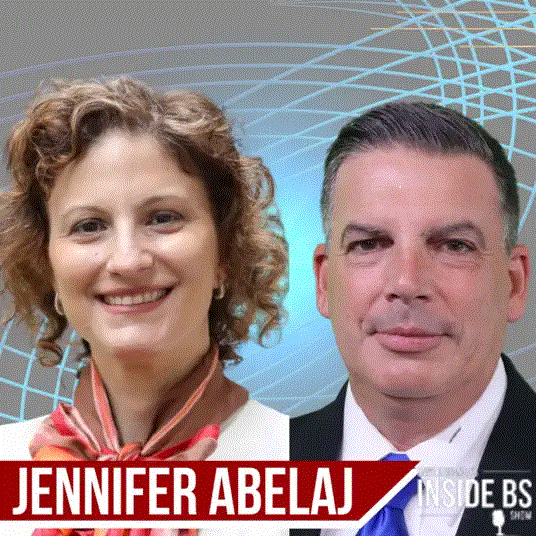
Jennifer V. Abelaj, Guest on the Inside BS Show Podcast, hosted by Dave Lorenzo: The Right Way to Plan Your Estate and Gifts to Charitable Institutions (Show 97, originally aired 06-29-2022)
I enjoyed my recent discussion with Dave Lorenzo, who is the host of The Inside BS Show podcast about The Right Way to Plan Your Estate and Gifts to Charitable Institutions.
Dave’s daily podcast includes informative discussions with professionals in the spaces of marketing, sales, business strategy and all the big secrets THEY don’t want you to know. The show will entertain you with great interviews, help you make more money, and give you the inside scoop on all the best secrets most people never share.
I’m so pleased to be a guest on this show and provide information about estate and philanthropic planning. I had a great time chatting with Dave, who is an excellent podcast host and an expert in sales techniques.
Below is a bio for the show, as well as a link to the audio and YouTube. Hopefully you get to learn more about Wills, Trusts and my passion for philanthropic planning. Let me know what you think!
_________________________________
The Right Way to Plan Your Estate and Gifts to Charitable Institutions
This show is important for anyone who cares about his/her family. Today Dave Lorenzo has a conversation with Jennifer Abelaj, a New York Estate Planning Attorney.
Join us!

Creating A Business Succession Plan
Starting and building a business is a work of a lifetime that requires making unsaid compromises and facing unknown hardships. Yet, when it comes to planning a future for their businesses, most business owners do not have a legal plan in place. The United States Small Business Administration reports that around 70 percent of privately owned businesses, with an estimated worth of $70 trillion, will change hands in the next 10–15 years. Yet, as reported by the National Association of Corporate Directors, only one in four private companies opt to have a formal succession plan in place. If you want to know more about creating a business succession plan for your business and about the legal process involved, consider contacting the experienced New York estate planning attorneys of Jennifer V. Abelaj Law Firm today by calling 212-328-9568.
What Is Business Succession Planning?
In simple words, business succession planning means preparing in advance for a change in the ownership of the business. This involves identifying the events that may cause the ownership change, establishing certain timelines and standard operating procedures, and identifying potential successors or key employees.
Unforeseen and unfortunate events, such as a family feud, death, severe illness, or disability, may require a sudden change in business ownership and management. Having a proper succession plan for a business is like having a will for a person. When a person prepares a will, that person decides what will happen to his or her wealth and property after he or she dies. Similarly, having a business succession plan in place ensures that the business has an exit or a transfer per the owner’s wishes.
Benefits of Having a Business Succession Plan
Creating a succession plan for one’s business has many benefits. Some of these benefits include:
- Smoothing the transition
- Maximizing value and minimizing loss
- Training future leaders or employees
- Identifying weaknesses
- Retaining key employees or creating roles
Smoothing the Transition
If the business is to be transferred to a family member, a succession plan enables a smooth and clear transition and avoids a potential family feud. Rather than leaving it to the court to decide what happens to the business, the decision is made by the business owner in advance when a plan is in place.
Maximizing Value and Minimizing Loss
If the business is to be sold or transferred to a third party, a pre-determined plan about how that transition will be handled helps to maximize the value of the business. Having a succession plan in place also helps to avoid a last minute or sudden sale below the market or fair value.
Training Future Leaders or Employees
Whether the business is to be transferred among family members or to a key employee, identifying the potential successor or successors allows time for sufficient training.
Identifying Weaknesses
While planning in advance, the owner may identify loopholes or inefficiencies in the business and will be able to make a plan to address those weaknesses.
Retaining Key Employees or Creating Roles
Certain employees are important to the success of the business. Further, a business owner may want to involve certain family members in the business. With succession planning, the business owner has the opportunity to retain those employees and create roles as needed for family members.
If you have been thinking about creating a business succession plan but are not sure about the best options for your business, a skilled estate planning attorney at Jennifer V. Abelaj Law Firm can help you better understand the steps involved in creating a sound business succession plan.
Steps To Create a Business Succession Plan
Creating a business succession plan involves considering multiple factors. Some of the most important steps involved in creating a business plan include the following:
- Identifying future goals
- Identifying potential successors
- Conducting a business valuation
- Completing estate and tax planning
- Making necessary changes to governing documents
- Selecting an exit option
- Selecting a team of professionals
Identifying Future Goals
While creating a business succession plan, the business owner needs to identify personal goals are and desires for the business. This includes retirement planning and, if the business is a family business, choosing whether to transfer the business to family members or opt for an exit strategy.
Identifying Potential Successors
A business owner must initiate an honest conversation with family members and identify who is most capable of running the business. Additionally, determine whether the family member is actually interested in running the family business in the future. Sometimes, however, a key employee may be best suited to run the business through an Employee Stock Ownership Plan. If there are no potential candidates, the business owner may consider selling the business.
Conducting a Business Valuation
Conducting a business valuation through an appraiser is important to the process of creating an appropriate business succession plan. A business valuation is done on the basis of revenues, potential incomes, debt, assets, pending litigation, and current market value.
Completing Estate and Tax Planning
Estate and tax planning is one of the most important steps in a business succession plan. Failing to plan these well can lead to unnecessary expenses. However, proper planning can minimize taxes.
Making Necessary Changes to Governing Documents
Making corresponding changes in the organization’s governing documents will ensure that those documents align with the succession plan. Any contrary terms or clauses in the company’s partnership agreement or shareholder agreement may later create a hurdle if not changed accordingly.
Selecting an Exit Option
Typically, business owners select one of four modes of exiting their own business:
- Transferring to a family member
- Making a sale deal with a key employee or a business partner
- Selling the company to a third party
- Closing and liquidating the company
Selecting a Team of Professionals
A good business succession plan addresses the multiple factors that impact the value and longevity of the business. Therefore, it is important to select a team that can handle the many aspects of succession planning.
Contacting a Business Succession Planning Attorney
Creating a business succession plan is a challenging and multidisciplinary task. One needs to consider family relationships, personal future goals, taxes, and other legal matters involved while making a solid succession plan. To learn more about your legal options and how you can create a succession plan for your business, consider contacting an experienced New York estate planning attorney at Jennifer V. Abelaj Law Firm today by calling 212-328-9568 to schedule a consultation.